The 6 Psychological Needs: SAPIEN
The SAPIEN Model: 6 Basic Needs
The SAPIEN Needs Model
Origins and Foundation
The book draws on decades of psychological needs theories — from Abraham Maslow’s hierarchy of needs to Manfred Max-Neef’s human scale development model, from Richard Ryan and Edward Deci’s basic psychological needs theory to Tony Robbins’s six psychological needs — and concludes that across all of these frameworks, six core psychological needs consistently emerge.
These needs are just as fundamental to our neural architecture as physical needs, and cause just as much conflict when threatened. When they are depleted or impeded, we feel extreme pain, discomfort, or distress and are highly motivated to reduce that discomfort.
Critically, psychological pain from the depletion of or perceived threat to our psychological needs is processed in many of the same brain regions that process physical pain and threats. Human beings throughout history become escalated and violent in reaction to perceived threats to their psychological needs, even when all physical needs are satisfied.
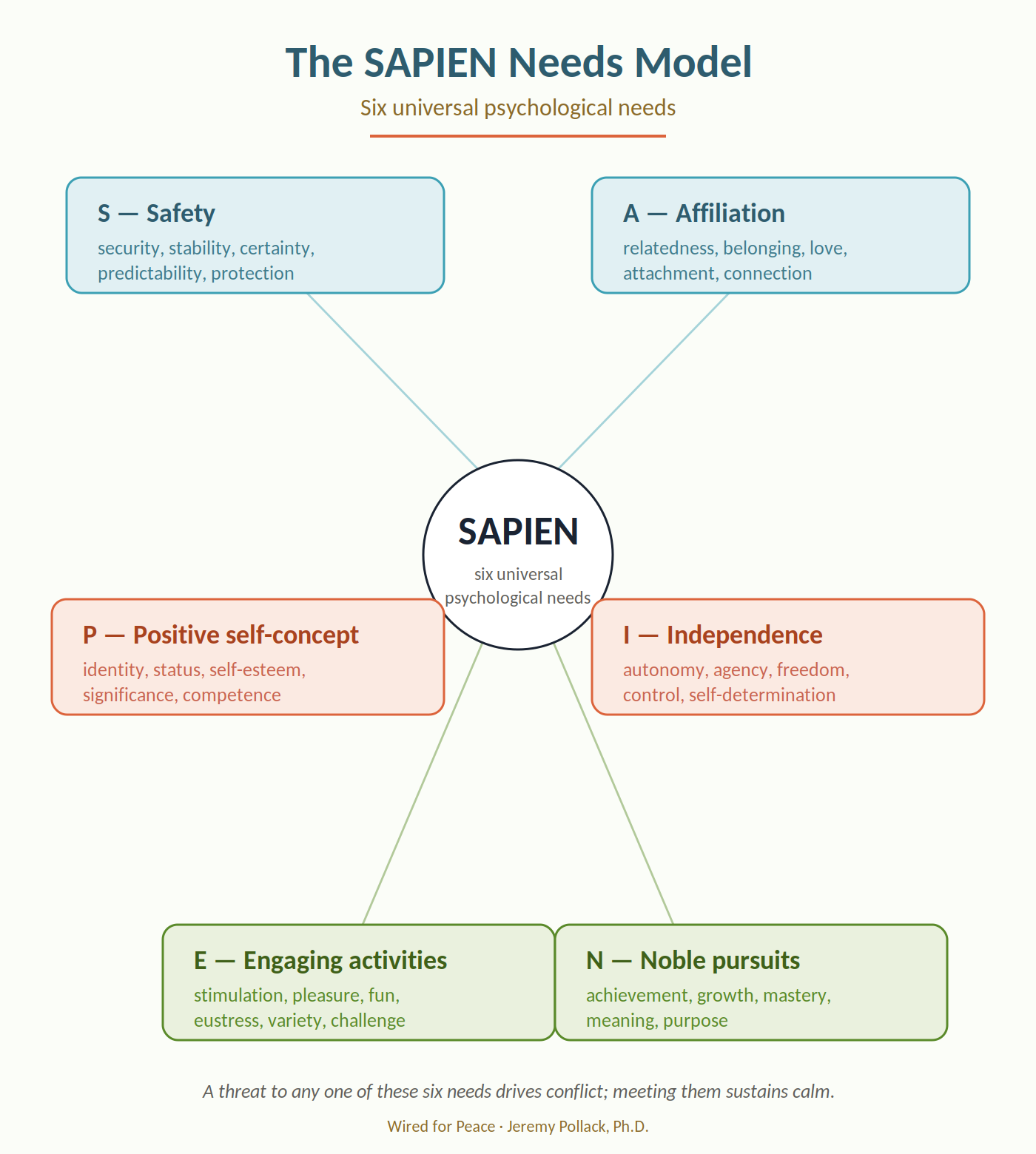
The Six Needs: S-A-P-I-E-N
S — Safety (stability, predictability, psychological safety)
Safety is a two-dimensional construct. The first dimension is the need for future security and stability — the need to feel that one’s world is somewhat predictable, including a stable source of income, stable housing, stable relationships, and nonviolence. This need is essentially a psychological manifestation of the brain’s most basic neurobiological operation: prediction.
The second dimension is psychological safety — the ability to take risks and make mistakes without fear of retaliation or humiliation. When people feel they must walk on eggshells to avoid being humiliated, attacked, rejected, or abandoned, all opportunities for growth are stunted and this need becomes depleted.
A — Affiliation (belonging, connection, relatedness)
The need for affiliation — also called relatedness, belonging, love, attachment, affection, unity, and connection — identifies the deep requirement to be cared for and paid attention to, as well as to be part of a group, family, or community.
This need likely evolved as a layer above safety, since infant humans cannot survive alone. Over evolutionary history, adult humans attempting to survive without a group would have had great difficulty. Hence, when we are abandoned, undesirably alone, or isolated, the need for affiliation becomes depleted.
P — Positive Self-Concept (self-worth, identity, self-esteem)
The need for positive self-concept has also been labeled identity, status, self-esteem, significance, competence, self-worth, value, and recognition. Self-concept is abstract and multidimensional, arising from both individual and social identities. When someone perceives they are not being accepted and valued because of some aspect of their identity, their self-concept is affected negatively and this need becomes depleted.
The book connects this need directly to conflict: the need for a positive self-concept is one of the most affected core needs when facing uncertainty or any challenge to our sense of rightness. Being “right” is often tied to being consistent with our mental model of who we are.
I — Independence (autonomy, agency, control, self-determination)
The need for independence has also been termed autonomy, agency, power, freedom, control, and self-determination. Human beings need to feel control over their lives and that they can make decisions autonomously, especially about important aspects such as health, money, and family. A tremendous amount of conflict arises from the perceived threat or impediment to this need.
E — Engaging Activities (stimulation, challenge, variety)
The need for engaging activities — also called stimulation, pleasure, leisure, fun, personal fulfillment, eustress, excitation, and variety — speaks to our drive to occupy our minds with something stimulating, even challenging in a positive way. When we are bored, unchallenged, or unstimulated on a regular basis, this need becomes diminished.
N — Noble Pursuits (purpose, meaning, growth, self-actualization)
The need for noble pursuits — also called achievement, growth, self-enhancement, mastery, transcendence, meaning, purpose, and self-actualization — is the need to feel we are on a right and meaningful path and that there is some purpose in what we are doing. When we lack a sense of purpose, meaning, growth, or meaningful goals, this need becomes depleted.
Why This Model Matters for Conflict
All values are construed and all goals are developed to serve our underlying, irreducible needs. Therefore, all escalated conflicts — all acute stress responses — erupt from a real or perceived threat to one or more of our basic physical or psychological needs. Needs are always the end game.
When these needs are consistently met, the brain’s predictive systems register the environment as nonthreatening, enabling the prefrontal cortex to remain active and parasympathetic dominance to be maintained. This downregulates amygdala reactivity and suppresses unnecessary activation of the HPA axis, reducing baseline cortisol levels and buffering against chronic stress.
In short, the SAPIEN model is the diagnostic lens the book uses throughout: every conflict, at its root, is a story about one or more of these six needs being threatened — and every durable resolution must address them.