Dialogue in organizations is defined as the structured exchange of meaning between people that builds shared understanding, trust, and collective commitment. It is not the same as ordinary conversation. Where conversation transfers information, dialogue aligns mental models and creates the conditions for real collaboration. Leaders who treat dialogue as a core practice, not a soft skill, see measurable gains in team performance, innovation, and employee engagement. The research is clear: psychological safety, which dialogue directly creates, is the single strongest predictor of team effectiveness.
What is the role of dialogue in organizations?
Dialogue is the mechanism through which organizations turn individual knowledge into collective action. Without it, teams operate on assumptions, leaders make decisions without full information, and employees disengage because they feel unheard. The role of dialogue in organizations goes far beyond keeping communication lines open. It determines whether your teams can solve hard problems, adapt to change, and hold together under pressure.
Talk builds shared meaning and commitment in ways that memos, dashboards, and email chains simply cannot. When people articulate their thinking out loud and hear others respond, they surface assumptions they did not know they held. That process of surfacing and testing assumptions is where alignment actually happens.

The distinction between dialogue and discussion matters here. Discussion is often about winning a point. Dialogue is about reaching a shared understanding that neither party could have reached alone. Leaders who confuse the two often run meetings that feel productive but produce no real commitment.
How does dialogue drive collaboration and innovation in teams?
Open, inclusive dialogue is the engine of team creativity. When team members feel free to share half-formed ideas without fear of judgment, those ideas get refined, combined, and improved by others. That process is where genuine innovation comes from. It does not happen in isolation.
Three specific outcomes emerge when teams practice collaborative dialogue consistently:
- Shared problem framing. Teams that talk through a problem before jumping to solutions consistently identify the real issue, not just the visible symptom. This prevents wasted effort on the wrong fix.
- Broader idea generation. When every voice contributes, the range of options on the table expands. Research confirms that equal conversational participation is a defining feature of high-performing teams.
- Faster alignment on goals. Teams that dialogue regularly spend less time relitigating decisions because everyone understands the reasoning, not just the outcome.
The practical implication for leaders is direct: create conditions where people speak and are genuinely heard. That means structuring meetings so quieter voices get airtime, not just the loudest or most senior ones. It also means modeling curiosity yourself. When leaders ask questions and listen visibly, teams follow.
Pro Tip: Run a “round-robin” at the start of key meetings where every person shares one thought before open discussion begins. This single practice redistributes conversational power and surfaces ideas that would otherwise stay silent.
How does psychological safety connect to dialogue and performance?
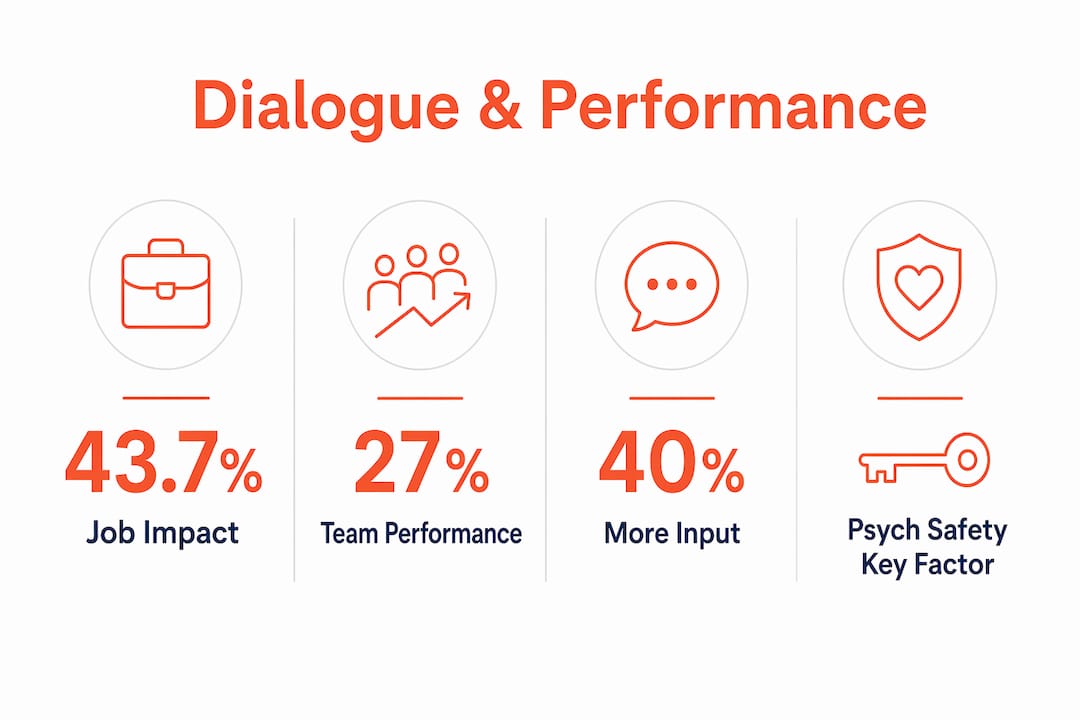
Psychological safety is the belief that you can speak up, disagree, or admit a mistake without being punished or humiliated. It is not about being comfortable or avoiding conflict. It is about making dissent survivable. Psychologically safe teams outperform others by 27%, showing more innovation and higher employee satisfaction. That gap is directly traceable to the quality of dialogue those teams practice.
The connection between dialogue and psychological safety runs in both directions. Dialogue creates psychological safety by demonstrating that candor is welcome. Psychological safety then enables deeper, more honest dialogue. Leaders break this cycle when they respond to bad news with blame or shut down disagreement with authority. Modeling fallibility and responding to failure with curiosity rather than blame is the most direct way to rebuild it.
The performance data on developmental dialogue is striking. Everyday coaching dialogues explain 43.7% of job performance variance, outperforming formal coaching programs. That figure means nearly half of what drives individual performance is explained by the quality of daily conversations between managers and their teams, not annual reviews or structured training.
| Dialogue Practice | Performance Impact |
|---|---|
| Equal conversational turn-taking | 27% higher team performance |
| Everyday coaching dialogues | 43.7% of job performance variance explained |
| Inquiry-based leadership (questions before advocacy) | 40% more team input received |
| Structured dialogue processes | Reduced status games and silent resistance |
Pro Tip: After a project setback, open your next team meeting with “What did we learn?” instead of “What went wrong?” The reframe signals curiosity over blame and keeps people talking honestly.
What are the common barriers to effective organizational dialogue?
Power imbalance is the most persistent barrier to honest dialogue in organizations. When a senior leader speaks first, most people in the room adjust their views to match. The result looks like agreement but is actually compliance. Structured dialogue reduces status games, promotes honesty, and prevents the silent resistance that follows fake consensus.
A second barrier is confusing talking with dialogue. Many organizations have plenty of meetings but very little genuine exchange. People speak past each other, defend positions, and leave without any shift in understanding. Real dialogue requires slowing down enough to examine your own assumptions before defending them.
A third barrier is the nodding agreement problem. Teams often signal agreement in the room and then quietly resist implementation afterward. This happens when dialogue has not actually produced commitment. Dialogue is not agreement. Its goal is trustworthy commitments, not unanimous approval. When people feel genuinely heard and understand the reasoning behind a decision, they commit more reliably, even when they disagree with the outcome.
Overcoming these barriers requires deliberate structure:
- Set conversational rules before the meeting starts. Agree that everyone speaks before anyone responds, that questions are welcome, and that rank does not determine whose idea wins.
- Use a neutral facilitator for high-stakes conversations. A facilitator manages the process so leaders can participate without dominating. This is especially useful in conflict situations where power dynamics are already charged.
- Close every dialogue with explicit commitments. Ask each person to state what they will do differently as a result of the conversation. Vague takeaways produce vague follow-through.
- Debrief the dialogue itself. Periodically ask your team how the conversation went, not just what was decided. This builds the team’s capacity to dialogue better over time.
What leadership practices build a culture of ongoing dialogue?
Leaders build dialogue cultures through consistent daily behavior, not through policy or training alone. Inquiry-based leadership produces 40% more team input when leaders ask genuine questions before advocating for their own position. That number reflects a simple truth: when leaders speak first, they close the conversation. When they ask first, they open it.
Several specific behaviors make the biggest difference:
- Ask before you tell. Open discussions with “What do you see here?” or “What am I missing?” before sharing your own view. This signals that your position is not already fixed.
- Respond to failure with curiosity. When something goes wrong, your first question shapes the culture. “What happened and what can we learn?” produces dialogue. “Who dropped the ball?” produces silence.
- Publicly acknowledge your own mistakes. When leaders model fallibility openly, they give everyone else permission to be honest about their own limitations.
- Make upward disagreement safe. Explicitly invite challenge. Say “I want to hear the case against this” and mean it. Teams watch whether you actually change your mind when presented with good arguments.
- Embed coaching conversations into daily work. Brief, frequent check-ins focused on learning and growth drive more performance than quarterly reviews. Daily dialogue as a coaching culture outperforms reliance on formal programs.
Accessible two-way communication from executives, translated into action by managers, builds trust and alignment across the organization. The key word is two-way. Broadcasting information is not dialogue. Dialogue requires that leaders genuinely receive what comes back.
Key Takeaways
Dialogue is the most direct lever leaders have for improving team performance, reducing conflict, and building a culture where people do their best work.
| Point | Details |
|---|---|
| Dialogue creates psychological safety | Teams with open dialogue outperform others by 27% through greater innovation and satisfaction. |
| Daily conversations drive performance | Everyday coaching dialogues explain 43.7% of job performance variance, more than formal programs. |
| Ask before you advocate | Leaders who ask genuine questions first receive 40% more team input and better decisions. |
| Structure reduces power barriers | Conversational rules and neutral facilitation prevent status games and silent resistance. |
| Dialogue produces commitment, not just agreement | The goal is trustworthy commitments from people who feel heard, not unanimous approval. |
Dialogue is the actual work, not the warm-up
Most leaders treat dialogue as preparation for the real work. They hold a conversation, then go do the thing. After years of working with leadership teams at Pollack Peacebuilding Systems, I have come to see that framing as backwards. Dialogue is the work. The moment your team surfaces a hidden assumption, names a real disagreement, or commits to a course of action they actually believe in, that is where organizational performance is made or lost.
The hardest part is not learning the techniques. It is slowing down enough to use them when the pressure is on. Under stress, leaders default to telling, not asking. They call for alignment when they mean compliance. They mistake a quiet room for a committed team. I have seen this pattern in organizations of every size and sector.
What actually changes culture is when leaders start treating every conversation as a chance to build trust, not just transfer information. That means tolerating the discomfort of genuine disagreement. It means staying curious when your instinct is to defend. It means managing conflict in organizations as a natural feature of healthy dialogue, not a sign that something has gone wrong.
The leaders I have seen make the most progress are not the ones who run the best meetings. They are the ones who make it genuinely safe to tell them the truth.
— Jeremy Pollack
How Pollack Peacebuilding Systems supports dialogue-driven leadership
Pollack Peacebuilding Systems works directly with organizational leaders to build the communication skills and systems that make genuine dialogue possible. Whether your team is navigating unresolved conflict, struggling with low trust, or simply talking past each other in critical meetings, the right support makes a measurable difference. Services include executive communication training, conflict and communication coaching, mediation, and organizational design. Each engagement is grounded in evidence-based conflict management frameworks built for real business environments. Contact Pollack Peacebuilding Systems to start building a culture where honest, productive dialogue is the norm.
FAQ
What is the difference between dialogue and discussion in organizations?
Dialogue builds shared understanding by surfacing and testing assumptions together. Discussion typically involves defending positions, while dialogue produces genuine commitment and alignment.
Why does psychological safety matter for organizational dialogue?
Psychologically safe teams outperform others by 27% because members speak honestly without fear of punishment. Psychological safety is the condition that makes real dialogue possible.
How can leaders increase team input during conversations?
Leaders who ask genuine questions before sharing their own position receive 40% more team input. Inquiry before advocacy is the single most effective behavior shift for leaders.
What role do everyday conversations play in employee performance?
Everyday coaching dialogues explain 43.7% of job performance variance. Frequent, developmental conversations between managers and teams drive more performance than formal coaching programs.
How does structured dialogue reduce conflict in teams?
Structured dialogue sets clear conversational rules that reduce status games and prevent silent resistance. It creates a space where honest commitments replace surface-level agreement, which is the root cause of most implementation failures.