Resolving team conflict at work is defined as applying targeted communication, mediation, and coaching methods to restore collaboration and productivity when workplace disagreements arise. Left unaddressed, conflict drains morale, slows output, and pushes good people out the door. The good news is that conflict resolution in teams is a learnable skill, not a personality trait. Pollack Peacebuilding Systems works with leaders every day who have turned persistent team friction into stronger working relationships by using the right approach for the right type of conflict.
What are the types of team conflict and why does identifying them matter?
Three main conflict types arise in organizations: task, relationship, and value conflicts. Each one requires a different resolution strategy. Treating all three the same way is one of the most common mistakes leaders make.
Task conflict centers on disagreements about work processes, goals, or responsibilities. A classic example is two department heads arguing over project ownership or budget allocation. Unclear roles contribute to 60% of workplace disputes, which means a large share of task conflicts are preventable with better role definition from the start.

Relationship conflict is personal. It involves friction between individuals based on personality clashes, communication styles, or past grievances. This type tends to escalate quickly because emotions run high. Without early intervention, relationship conflict poisons team culture and makes collaboration nearly impossible.
Value conflict is the most difficult to resolve. It occurs when people hold fundamentally different beliefs about ethics, priorities, or how work should be done. A values conflict in the workplace might look like a team member who prioritizes speed clashing with one who prioritizes thoroughness, or disagreements rooted in cultural or ethical differences.
Identifying the conflict type early matters for three concrete reasons:
- Task conflicts respond well to structural fixes like clearer role definitions, updated processes, or facilitated problem-solving sessions.
- Relationship conflicts need interpersonal skill-building, empathy exercises, and sometimes third-party mediation.
- Value conflicts require patience and a shift away from seeking compromise toward building mutual respect and professional coexistence.
Skipping the identification step means applying the wrong tool. A leader who tries to solve a values conflict with a process chart will make things worse, not better.
How do communication and active listening skills resolve workplace conflicts?
Active listening, empathy, and structured communication are the foundation of every effective conflict resolution process. Without them, even the best formal strategies fall apart. These skills are not soft extras. They are the mechanism through which tension de-escalates.
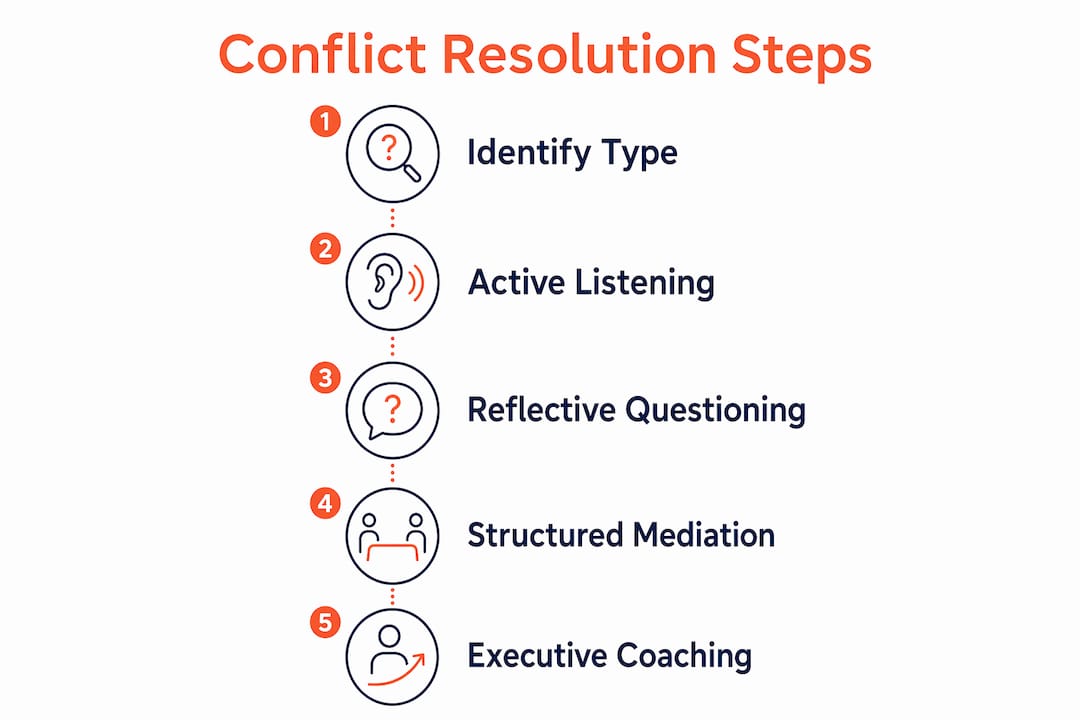
Active listening means giving your full attention, not just waiting for your turn to speak. It involves maintaining eye contact, avoiding interruptions, and reflecting back what you heard before responding. A simple technique called the listen-first round works well in group settings: each person speaks uninterrupted for two minutes while others listen without reacting. This alone reduces defensiveness significantly.
Reflective questioning is equally powerful. Instead of asking “Why did you do that?” try “Help me understand what you were trying to accomplish.” The first question triggers defensiveness. The second opens a real conversation. When you navigate conflict with a difficult coworker, this shift in language can change the entire dynamic of the interaction.
Empathy does not mean agreeing with the other person. It means acknowledging that their experience is real to them. Saying “I can see this situation has been frustrating for you” costs nothing and often breaks a stalemate faster than any formal process.
Common communication pitfalls to avoid during conflict discussions include:
- Interrupting before the other person finishes their point
- Using “you always” or “you never” language, which triggers defensiveness
- Bringing up unrelated past grievances during a current dispute
- Allowing one person to dominate the conversation without intervention
- Jumping to solutions before both parties feel fully heard
Pro Tip: When one person dominates a group conflict discussion, use structured turn-taking with a visible timer. Give each participant exactly two minutes to speak without interruption. This simple structure levels the playing field and prevents the loudest voice from controlling the outcome.
Facilitating balanced conversations is a leadership skill. Your job is not to take sides. Your job is to create conditions where both parties can speak honestly and feel heard. That shift in role, from judge to facilitator, changes everything.
What structured strategies accelerate team conflict resolution?
Formal resolution methods reduce both the duration and intensity of workplace disputes. Two of the most effective are structured mediation and executive coaching.
Structured mediation with a neutral third party
Mediation involves a neutral facilitator who guides both parties through a structured process. The steps typically follow this sequence:
- Set ground rules. Both parties agree to speak respectfully, avoid interruptions, and focus on the issue rather than the person.
- Gather facts. Each party shares their perspective without interruption. The mediator listens and takes notes.
- Identify shared interests. The mediator helps both sides find common ground, even when positions seem opposite.
- Generate options. Both parties brainstorm possible solutions together rather than having one imposed on them.
- Reach a written agreement. Commitments are documented so both parties are accountable.
Organizations using structured mediation resolve executive conflicts 30% faster than those relying only on internal measures. That speed matters because prolonged conflict costs real money in lost productivity, turnover, and damaged client relationships.
Executive coaching for emotional intelligence
Executive coaching focused on emotional intelligence and communication skills reduces interpersonal conflicts by 38%. Coaching works because it addresses the root cause rather than the symptom. Leaders who understand their own emotional triggers are far less likely to escalate a disagreement into a full team crisis.
Pollack Peacebuilding Systems uses a framework that addresses four core dimensions: clarity, capacity, capability, and conduct. Clarity means everyone understands their roles and expectations. Capacity refers to the time and resources available for resolution. Capability covers the skills needed to communicate effectively. Conduct sets the behavioral standards the team agrees to uphold.
| Method | Best for | Timeline | Key benefit |
|---|---|---|---|
| Informal conversation | Task and early relationship conflicts | Days | Fast, low cost |
| Facilitated discussion | Ongoing relationship conflicts | 1–2 weeks | Structured but internal |
| Formal mediation | Escalated or values conflicts | 2–4 weeks | Neutral, documented |
| Executive coaching | Leadership and recurring conflicts | 1–3 months | Addresses root causes |
Pro Tip: Involve HR or an external consultant when the conflict involves a power imbalance, a harassment claim, or when internal attempts have already failed. Waiting too long to escalate is one of the most common and costly mistakes leaders make.
When you handle executive team conflict, the stakes are higher because leadership disputes ripple through the entire organization. Formal mediation with an external neutral is often the fastest path to resolution at that level.
How can leaders manage ongoing conflicts and difficult coworkers?
Managing ongoing conflict between coworkers requires a different mindset than resolving a single incident. Persistent disputes need sustained attention, not a one-time conversation. The goal shifts from resolution to professional coexistence, especially when values are at the core of the disagreement.
Value conflicts require patience and a shift from seeking compromise to building mutual understanding. Forcing two people with fundamentally different values to agree rarely works. What does work is helping them find a way to work alongside each other productively, even without shared beliefs.
Two specific tactics accelerate this process. First, symbolic concessions on core values signal good faith and encourage the other party to reciprocate. A symbolic concession might be as simple as publicly acknowledging the other person’s commitment to quality, even while disagreeing with their approach. Second, affirming the positive qualities of the opposing party softens firm stances and opens space for value creation rather than entrenchment.
Practical steps for managing difficult coworkers over time include:
- Build rapport before conflict arises by investing in small, consistent positive interactions.
- Address friction early, before it calcifies into a fixed narrative about the other person.
- Document conversations and agreements so both parties remain accountable.
- Follow up two weeks after any resolution conversation to check whether commitments are being kept.
- Know when to escalate. If behavior does not change after two documented conversations, involve HR or a senior leader.
Pro Tip: When a coworker relationship feels permanently damaged, try a structured “reset conversation” with a neutral facilitator present. Set a single agenda item: agreeing on how you will work together going forward, not relitigating the past. This narrow focus prevents the conversation from spiraling.
Avoiding common mistakes is just as important as applying the right tactics. The biggest errors leaders make include avoiding the conflict entirely, taking sides publicly, and failing to follow up after a resolution conversation. Each of these mistakes signals to the team that conflict has no real consequence, which invites more of it.
Key Takeaways
Resolving team conflict at work requires identifying the conflict type first, then applying the right communication skills, structured methods, and follow-through to restore lasting collaboration.
| Point | Details |
|---|---|
| Identify the conflict type | Task, relationship, and value conflicts each need a different resolution approach. |
| Use active listening first | Listen-first rounds and reflective questioning reduce defensiveness before any formal process begins. |
| Apply structured mediation | Neutral third-party mediation resolves conflicts 30% faster than internal-only approaches. |
| Invest in executive coaching | Coaching focused on emotional intelligence reduces interpersonal conflicts by 38%. |
| Manage values conflicts differently | Aim for professional coexistence and mutual respect, not forced agreement. |
What I have learned from years of working through team conflict
The most common mistake I see leaders make is waiting too long. By the time they call us at Pollack Peacebuilding Systems, the conflict has been running for months. Trust is eroded. Sides have formed. What could have been a two-hour facilitated conversation has become a months-long intervention.
Early intervention is not weakness. It is the most efficient leadership decision you can make. A conflict addressed in week one costs a fraction of what it costs in month six, in time, in morale, and in turnover.
The second thing I have learned is that value conflicts are genuinely hard, and most leaders underestimate that difficulty. They expect a mediation session to produce agreement. When it does not, they feel like the process failed. But the goal in a values conflict is not agreement. It is professional coexistence. Two people can hold different beliefs and still collaborate effectively if they both commit to mutual respect. That reframe alone changes how leaders approach these situations.
Finally, I believe that conflict resolution is a culture, not an event. Organizations that handle disputes well do not just respond better. They prevent more conflicts from escalating in the first place. They have clearer roles, better communication norms, and leaders who model the behavior they expect. Building that culture takes time, but every resolved conflict is a deposit in that account.
Pollack Peacebuilding Systems: professional support for workplace conflict
Conflict does not resolve itself. When your team needs structured support, Pollack Peacebuilding Systems offers mediation, coaching, and training programs built for real workplace dynamics.

Our online workplace mediation services connect your team with a neutral facilitator quickly, regardless of location. For leaders dealing with recurring disputes, our conflict management coaching addresses the communication patterns and emotional triggers that keep conflicts alive. We also serve specialized sectors, including healthcare organizations through our healthcare conflict resolution programs and nonprofits through dedicated training. Every engagement is grounded in evidence-based frameworks and focused on measurable outcomes for your team.
Recommended
Frequently Asked Questions
Task, relationship, and value conflicts are the three main types. Each requires a different resolution strategy, which is why identifying the type before acting is the critical first step.
Structured mediation with a neutral third party resolves conflicts 30% faster than internal-only approaches. The process sets ground rules, gathers facts from both sides, and produces a written agreement that holds both parties accountable.
Active listening, reflective questioning, and empathy are the most effective skills. Techniques like listen-first rounds and avoiding “you always” language reduce defensiveness and open real dialogue between conflicting parties.
Escalate to HR when the conflict involves a power imbalance, a harassment claim, or when two documented internal conversations have not produced a behavior change. Waiting too long to involve HR increases legal and organizational risk.
Values conflicts rarely end in full agreement. The realistic goal is professional coexistence, where both parties commit to mutual respect and productive collaboration without requiring shared beliefs.