Team burnout is a collective state of chronic exhaustion caused by persistent workplace stressors, with unresolved conflict identified as a primary driver that erodes team community and performance. The formal clinical term is occupational burnout, defined by Christina Maslach and Michael Leiter through six workplace mismatches — workload, control, reward, community, fairness, and values — where misalignment in three or more areas reliably produces burnout. With team burnout and conflict explained through this systemic lens, executive leaders and HR professionals can move beyond individual-level fixes and address the organizational conditions that actually cause both problems. Pollackpeacebuilding works with leadership teams every day to untangle these dynamics before they damage retention, morale, and performance.
What are the key signs of team burnout in the workplace?
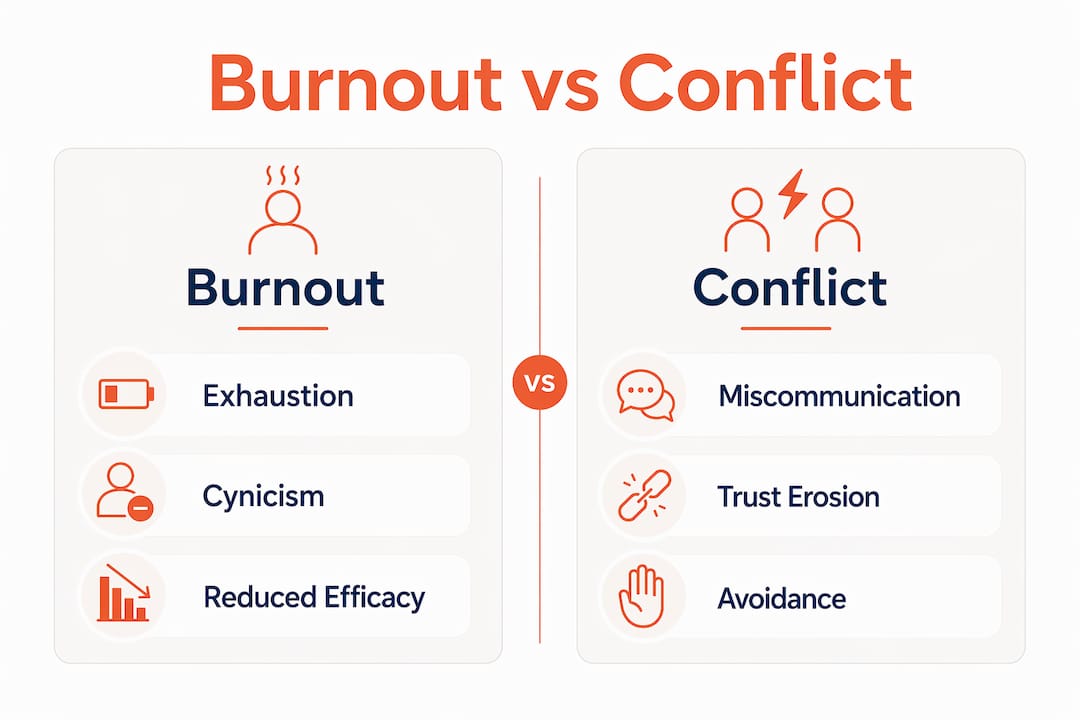
Occupational burnout at the team level manifests across three core dimensions: exhaustion, cynicism, and reduced efficacy. Burnout builds slowly, often becoming visible only after prolonged stress exposure, which is why many leaders miss it until significant damage is done. Recognizing the early signs gives you the window to intervene before the team reaches a breaking point.
Team-level burnout differs from individual burnout in one critical way: it spreads. When one high-performing team member disengages, their withdrawal shifts workload and emotional labor onto others, accelerating the cycle across the group. You are not managing one person’s stress. You are managing a contagion.
Common signs of team burnout include:
- Declining output quality with no clear operational cause
- Reduced participation in meetings, especially from previously vocal contributors
- Increased sick days and unexplained absences
- Shorter, more guarded communication in writing and conversation
- Cynical or dismissive language about company goals and leadership decisions
- Missed deadlines that were previously never an issue
Pro Tip: Watch for what stops happening, not just what goes wrong. When a team member who used to ask questions in all-hands meetings goes silent, that behavioral shift is a more reliable early signal than any engagement survey.
The behavioral micro-cues matter as much as the visible performance drops. A team that has shifted from open debate to cautious agreement is often not aligned. It is exhausted and disengaged. That distinction changes how you respond.
How does unresolved conflict drive team burnout?
Unresolved workplace conflict is both a symptom and a cause of burnout. It creates a feedback loop that, without intervention, compounds over time. Conflict radiates through organizations, driving absenteeism, turnover, low morale, and healthcare costs. It does not resolve itself.
In Maslach and Leiter’s framework, community mismatch is the specific burnout driver most tied to interpersonal conflict. Community mismatch occurs when the social fabric of a team breaks down: trust erodes, collaboration becomes transactional, and psychological safety disappears. When team members cannot rely on each other or feel chronically unsafe raising concerns, exhaustion, cynicism, and inefficacy follow predictably.
“Conflict rarely resolves without structured intervention. Leaders who wait for disputes to settle on their own are, in most cases, watching burnout take root.” — Advanced Mediation Solutions
The escalation pattern typically follows a recognizable sequence:
- Unaddressed tension forms between team members or between a team member and a manager.
- Avoidance behaviors emerge: people stop collaborating directly, route communication through intermediaries, or disengage from shared goals.
- Psychological safety collapses, and the team stops surfacing problems early.
- Chronic stress accumulates, producing the exhaustion and cynicism that define burnout.
- Performance drops become visible, often misread as a capability or motivation problem rather than a conflict and stress problem.
Conflict management research from Harvard PON confirms that most workplace conflict originates in miscommunication rather than genuine personality incompatibility. That finding matters because it means most conflicts are resolvable with the right structure and facilitation.
Pro Tip: If two team members have stopped collaborating directly and now route all communication through a third party or in writing only, treat that as a conflict escalation signal requiring immediate attention, not a communication style preference.

Professional mediation is the most underutilized tool available to HR leaders facing entrenched team conflict. It provides a confidential, neutral process for resolving disputes between coworkers, supervisors, and teams before burnout worsens. Pollackpeacebuilding’s coworker conflict resolution services are specifically designed for these situations.
What misconceptions about burnout and conflict hold leaders back?
Several persistent misconceptions prevent leaders from addressing team burnout and conflict at the right level. Understanding what these misconceptions are is the first step toward managing team conflict more effectively.
The most damaging misconceptions include:
- Burnout is a personal failing. Burnout is a systemic problem embedded in organizational culture and workload design. Treating it as an individual’s responsibility to manage shifts accountability away from the structural conditions that cause it.
- Surface harmony means a healthy team. Silent conflict is more dangerous than overt disputes. A team that never disagrees openly is often suppressing tension, not resolving it.
- Wellness programs solve burnout. Individual wellness initiatives provide modest, short-lived relief. Organizational interventions like workflow redesign and leadership accountability produce lasting results.
- Conflict will resolve on its own. Without structured intervention, conflict escalates. Waiting is not a neutral act. It is a decision to let the situation worsen.
The table below clarifies the difference between common assumptions and the evidence-based reality:
| Common assumption | Evidence-based reality |
|---|---|
| Burnout is an individual problem | Burnout is caused by organizational mismatches, not personal weakness |
| A quiet team is a healthy team | Silence often signals suppressed conflict and hidden burnout |
| Wellness perks prevent burnout | Systemic fixes like role clarity and workload redesign are required |
| Conflict fades without intervention | Unresolved conflict spreads and deepens burnout across the team |
The misconception that carries the highest cost is the wellness program trap. Many organizations invest heavily in gym memberships, mental health apps, and mindfulness sessions while leaving the root causes of burnout, such as unclear roles, unfair workloads, and unresolved interpersonal disputes, completely intact. The relief is real but temporary. The structural problems remain.
What organizational strategies effectively prevent and resolve burnout and conflict?
Addressing employee burnout causes and resolving workplace conflict requires organizational-level action, not just individual support. The following strategies represent the most effective approaches available to executive leaders and HR professionals.
- Redesign workflows and clarify roles. Ambiguity in responsibilities is a direct workload and control mismatch. Conduct a role clarity audit across your teams and eliminate overlapping or undefined accountabilities.
- Build psychological safety as a leadership practice. Psychological safety requires consistent leadership behavior: welcoming dissent, responding constructively to problems raised early, and modeling vulnerability. It is not a culture statement. It is a daily practice.
- Intervene in conflict early and directly. Early private conversations, effective feedback, and joint problem-solving prevent escalation and build trust. Waiting for conflict to become undeniable is the most common and most costly leadership mistake.
- Engage professional mediation for entrenched disputes. When internal conversations have failed or the power dynamics make neutral facilitation necessary, professional mediation provides the structure that internal managers cannot. Pollackpeacebuilding’s online workplace mediation services make this accessible regardless of team location.
- Hold leadership accountable for team health metrics. Burnout and conflict are leadership outcomes. Track indicators like voluntary turnover, absenteeism, engagement scores, and conflict escalation rates as leadership performance data, not just HR data.
Pro Tip: Measure team health quarterly using three direct questions: “Do you feel heard by your manager?” “Do you trust your teammates to do their part?” “Do you feel your workload is fair?” The answers will surface burnout and conflict risk before either becomes a crisis.
Effective conflict resolution strategies also require leaders to shift their role. Harvard PON research identifies the most effective leaders as those who take authentic roles as mediator, teacher, or relationship builder rather than operating purely as task managers. That shift in identity is where most leadership development programs fall short. You can learn more about managing employee conflict through Pollackpeacebuilding’s leadership resources.
Key Takeaways
Team burnout and unresolved conflict are systemic organizational failures that require structural interventions, not individual wellness fixes, to resolve sustainably.
| Point | Details |
|---|---|
| Burnout is systemic, not personal | Maslach and Leiter’s six mismatches show burnout originates in organizational conditions, not individual weakness. |
| Conflict drives community mismatch | Unresolved interpersonal conflict erodes team trust and is a primary burnout accelerator. |
| Silent conflict is the greater risk | Surface harmony masks hidden tension; behavioral micro-cues signal burnout before performance drops. |
| Organizational fixes outperform wellness programs | Workflow redesign and leadership accountability produce lasting burnout reduction; perks do not. |
| Early mediation prevents escalation | Structured intervention at the first signs of conflict stops the burnout cycle before it spreads. |
What I’ve learned from watching leaders misread their own teams
Most leaders I work with are not ignoring burnout and conflict. They are misreading them. They see a quiet team and call it cohesion. They see a team that never pushes back and call it alignment. What they are actually seeing, in most cases, is a group of people who have learned that speaking up carries a cost.
The hardest shift for executives to make is accepting that their team’s silence is feedback about their leadership, not evidence of satisfaction. When I work with leadership teams, the most revealing moment is often when a leader hears, for the first time in a structured mediation setting, what their team has been carrying for months without saying.
I have also seen the opposite failure: leaders who recognize conflict but wait for it to resolve naturally. Conflict does not resolve naturally in hierarchical environments. The power dynamics that create workplace tension also suppress the direct conversations that would resolve it. That is exactly why neutral, structured mediation exists. It creates a container where honest conversation becomes possible again.
The cultural shift that produces lasting results is not a new policy or a wellness benefit. It is a leadership team that treats team health as a performance metric and responds to early signals with curiosity rather than defensiveness. That shift is learnable. It just requires the right framework and, often, the right outside support.
— Jeremy Pollack, How Pollack Peacebuilding Systems helps leaders address burnout and conflict
When burnout and conflict are intertwined in your organization, the path forward requires more than a training session or a policy update. It requires structured, expert-guided intervention.

Pollackpeacebuilding specializes in workplace conflict resolution consulting for executive leaders and HR professionals who need to address the human dynamics undermining their team’s performance. From professional mediation and facilitated dialogue to leadership communication training and organizational systems design, the services are built around the evidence-based frameworks covered in this article. If your team is showing signs of burnout, entrenched conflict, or eroding trust, the right time to act is before those conditions become a retention or performance crisis. Reach out to Pollackpeacebuilding to explore the right intervention for your organization.
Frequently Asked Questions
Individual burnout affects one person’s exhaustion and efficacy, while team burnout spreads across the group as disengagement, workload shifts, and eroded trust compound each other. Team burnout is a systemic condition requiring organizational intervention, not just individual support.
The most reliable early signs include reduced participation in meetings, shorter and more guarded communication, increased absenteeism, and cynical language about organizational goals. Behavioral micro-cues like a previously vocal team member going silent are often more accurate than engagement survey scores.
Unresolved conflict creates community mismatch, one of Maslach and Leiter’s six core burnout drivers, by eroding trust, collapsing psychological safety, and forcing team members into chronic stress. Without structured intervention, conflict spreads through teams and deepens burnout over time.
Wellness programs provide short-term relief but do not address the systemic causes of burnout. Research shows organizational interventions like workflow redesign, role clarity, and leadership accountability produce more sustainable burnout reduction than individual wellness initiatives.
Professional mediation is appropriate when internal conversations have failed, when power dynamics prevent honest dialogue, or when conflict has persisted long enough to affect team performance and morale. Early mediation is significantly more effective than waiting for disputes to escalate.