Workplace conflict is defined as any interpersonal or group tension that disrupts collaboration, communication, or performance within an organization. The financial and productivity impact of unresolved conflict is severe: organizations lose output to distraction, spend heavily on legal disputes, and watch talented employees walk out the door. Research shows that 46% of UK organizations incurred direct financial losses from workplace disputes in the past three years, with 16% spending over £40,000 per issue. Understanding why workplace conflict costs organizations so much requires looking beyond individual personality clashes to the systemic forces that let tension fester and escalate.
What are the main costs organizations face from unresolved conflict?
The costs of employee disputes fall into several distinct categories. Each one compounds the others, which is why unresolved conflict rarely stays contained to one department or one team.
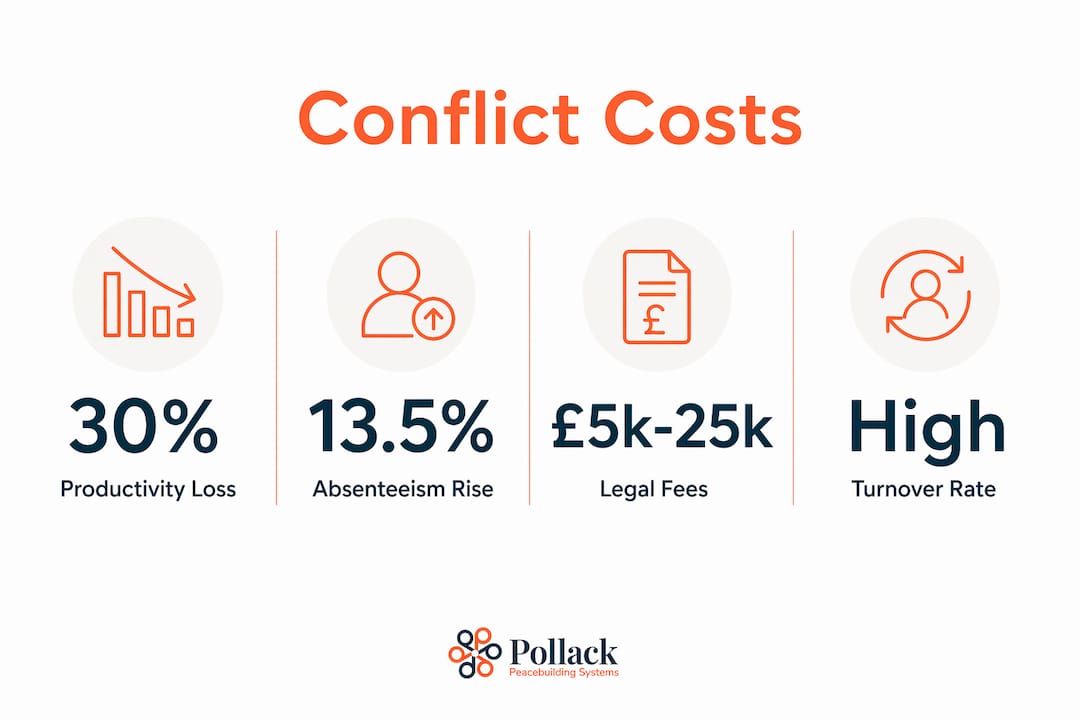
Lost productivity is the most immediate cost. When employees are caught in conflict, they spend mental energy managing tension rather than doing their jobs. Research consistently links conflict and reduced productivity, showing that disengagement spreads quickly from the individuals directly involved to the broader team.

Employee turnover carries a steep price tag. Conflict with superiors drives voluntary turnover at measurable rates, and replacing those employees is expensive. Recruitment costs for replacement staff typically range from £3,000 to £12,000 per hire depending on role and seniority. That figure does not include onboarding time, lost institutional knowledge, or the reduced output of a new hire during their first months.
Absenteeism rises sharply when conflict goes unaddressed. Conflict with superiors produces a 13.57% rise in sickness absence. That number represents real days lost, real workloads redistributed, and real pressure placed on the colleagues who remain.
Legal and HR costs represent the most visible financial exposure. Employment tribunal defense costs, combined with 40–80 hours of management time per case, drive expenses well beyond what most leaders anticipate. Legal fees for unfair dismissal typically range from £5,000 to £25,000, with complex discrimination cases exceeding £50,000.
The impact of workplace conflict also reaches your customers. Frontline employees managing internal tension deliver worse service. Customer complaints rise, satisfaction scores drop, and the reputational damage can outlast the original dispute.
Here is a summary of the primary cost categories:
- Productivity loss: Distraction, disengagement, and reduced output across affected teams
- Turnover costs: Recruitment, onboarding, and lost knowledge from conflict-driven departures
- Absenteeism: Increased sick days and stress leave linked directly to unresolved tension
- Legal expenses: Tribunal fees, management time, and settlement costs
- Customer impact: Declining service quality and satisfaction from stressed frontline staff
- Leadership distraction: Senior time diverted from growth priorities to managing disputes
How do communication failures drive conflict costs more than difficult employees?
Most organizations frame conflict as a people problem. They identify the “difficult employee” and focus their energy there. This approach misses the root cause in the majority of cases.
Communication breakdown is the primary driver of escalating conflict costs. When expectations go unstated, roles overlap without clarity, or feedback is delivered poorly, tension builds regardless of who is involved. The empirical record on workplace conflict shows that “candid” cultures with chronic time pressure and status competition consistently undermine constructive conflict and drive costs upward. The system creates the conditions; the people react to them.
Organizational design failures compound this problem. Unclear reporting lines, misaligned incentives, and inconsistent leadership norms all generate friction. When two departments share a goal but compete for resources, conflict is not a personality issue. It is a structural one.
Unmet needs accelerate the damage. Employees who feel unheard, undervalued, or unsupported do not simply disengage quietly. They escalate, withdraw, or leave. Each of those responses carries a measurable cost to your organization.
Pro Tip: Before labeling a conflict as interpersonal, map the organizational conditions around it. Ask whether unclear roles, inconsistent communication norms, or competing incentives are contributing. Fixing the system often resolves the conflict faster than coaching the individuals.
The most costly conflicts share a common pattern:
- Expectations were never clearly communicated
- Feedback was delayed or delivered in a way that felt punitive
- Leadership modeled avoidance rather than direct resolution
- The conflict was treated as a one-time incident rather than a signal of a systemic gap
What are the overlooked warning signs of costly conflict escalation?
Most organizations respond to conflict after it has already become expensive. The warning signs appear well before a formal complaint is filed or a resignation letter lands on your desk.
- Increased micromanaging or leadership withdrawal. When managers start over-controlling their teams or pulling back from engagement entirely, they are often responding to unresolved tension they do not know how to address.
- Rising informal complaints and gossip. An uptick in side conversations, hallway venting, or anonymous feedback is a reliable early signal. Employees talk about what they cannot resolve through formal channels.
- Drop in collaboration and idea-sharing. Teams in conflict stop contributing in meetings. Innovation indicators decline. Participation in cross-functional projects falls off. These are measurable changes that show up in project timelines and output quality.
- Shifts in absenteeism patterns. Conflict-related absence does not always look like a spike. Watch for patterns: specific individuals calling in sick on Mondays, clusters of absence in one team, or a rise in short-term leave requests.
- Customer complaints linked to frontline tension. When internal conflict reaches customer-facing roles, service quality degrades. A rise in complaints about responsiveness, tone, or follow-through often traces back to team tension rather than individual performance.
Catching these signals early gives your organization the chance to intervene before the costs compound. The common patterns in leadership conflicts show that most escalations follow a predictable path. Early recognition is the most cost-effective intervention available.
What strategies reduce the economic impact of workplace conflict?
Reducing conflict management costs requires both immediate interventions and longer-term system changes. The most effective organizations treat conflict resolution as an ongoing practice, not a crisis response.
Upskill your leaders first. Focusing conflict management training and coaching on leadership yields greater returns than broad team-level interventions. Conflicts with managers drive the absenteeism and turnover numbers that hit your budget hardest. Leadership conflict management training gives managers the skills to address tension early, before it escalates into formal disputes.
Adopt the Problem Solving conflict management style. The Problem Solving approach is the most effective conflict management style according to business psychology research. Avoiding styles are directly linked to worsening performance and deteriorating relationships. Training leaders to use Problem Solving reduces costs and preserves collaboration across teams.
Implement structured communication protocols. Regular one-on-ones, clear escalation pathways, and documented role expectations reduce the ambiguity that fuels conflict. These are low-cost structural changes with measurable impact on team cohesion.
Deploy proactive mediation and conflict coaching. Waiting for formal complaints to trigger intervention is the most expensive approach. Proactive conflict coaching and mediation programs address tension before it reaches the legal or HR stage.
Build psychological safety into your culture. Research confirms that constructive conflict, the kind that improves decisions and drives innovation, only occurs when teams have cooperative goals and psychological safety. Without it, even well-intentioned disagreements become costly.
Pro Tip: Measure your conflict costs annually. Track absenteeism rates, voluntary turnover, HR case volume, and management time spent on disputes. Putting a number on the problem makes the business case for prevention programs undeniable.
The table below compares reactive and proactive conflict management approaches across key performance dimensions:
| Dimension | Reactive approach | Proactive approach |
|---|---|---|
| Cost timing | High costs after escalation | Lower ongoing investment |
| Absenteeism impact | Addressed after patterns emerge | Reduced through early intervention |
| Turnover risk | Managed after resignation | Mitigated through leadership coaching |
| Legal exposure | Triggered by formal complaints | Reduced by structured resolution processes |
| Team morale | Restored slowly after damage | Maintained through consistent communication |
Key Takeaways
Unresolved workplace conflict costs organizations through compounding losses in productivity, turnover, absenteeism, legal fees, and customer experience, all of which are preventable with proactive, system-level intervention.
| Point | Details |
|---|---|
| Conflict costs are systemic | Most costly conflict stems from communication failures and unclear roles, not difficult individuals. |
| Turnover is a major expense | Conflict-driven departures cost organizations thousands per hire in recruitment and onboarding alone. |
| Absenteeism rises measurably | Conflict with managers produces a 13.57% rise in sickness absence, a direct budget impact. |
| Legal costs surprise most leaders | Even winning a tribunal costs 40–80 hours of management time plus thousands in legal fees. |
| Prevention outperforms reaction | Upskilling leaders and deploying proactive mediation reduces costs before they compound. |
The cost of waiting: why conflict prevention is a leadership priority
Organizations consistently underestimate how much unresolved conflict costs them. I have seen this pattern repeat across industries: leadership treats conflict as an HR problem, HR treats it as a people problem, and no one treats it as the organizational performance problem it actually is.
The research is clear that most workplace conflict does not come from bad people. It comes from bad systems. Unclear expectations, poor communication norms, and leadership that models avoidance rather than resolution create the conditions for tension to grow. By the time a formal complaint lands, the organization has already absorbed months of lost productivity, rising absenteeism, and quiet disengagement.
The misconception I encounter most often is the belief that some conflict is healthy and therefore conflict management is unnecessary. That framing is a misreading of the evidence. Constructive conflict, the kind that sharpens decisions and surfaces better ideas, only occurs under specific conditions: cooperative goals, psychological safety, and a shared commitment to resolution. Without those conditions, conflict reduces performance. Full stop.
My recommendation to executives and HR leaders is direct: treat conflict management as a leadership capability, not a remediation tool. The organizations that invest in upskilling their managers, building structured communication practices, and deploying proactive mediation programs do not just reduce costs. They build the kind of culture where people stay, perform, and contribute at their best.
— Conflict Resolution Expert | Jeremy Pollack, Ph.D.
How Pollack Peacebuilding Systems can help reduce your conflict costs
Pollack Peacebuilding Systems works with organizations across healthcare, nonprofits, and corporate leadership to reduce the financial and human costs of unresolved conflict.
Our conflict management consulting services combine evidence-based frameworks with practical organizational strategies. We offer workplace mediation, executive communication coaching, leadership conflict training, and culture optimization programs designed to address both immediate disputes and the systemic conditions that create them. Whether your organization needs online workplace mediation to resolve an active dispute or a longer-term consulting engagement to reduce conflict at the system level, Pollack Peacebuilding Systems has a solution built for your context. Contact us to discuss where conflict is costing your organization most.
FAQ
What is the average cost of a workplace conflict dispute?
Direct costs vary widely by severity. Legal fees for employment tribunal defense typically range from £5,000 to £25,000 for straightforward claims, with complex discrimination cases exceeding £50,000, plus 40–80 hours of management time per case.
Why does conflict with managers cost more than peer-to-peer conflict?
Conflict with superiors drives both a measurable rise in sickness absence and higher voluntary turnover rates. Because managers influence the daily experience of entire teams, unresolved tension at that level multiplies its impact across the organization.
Can workplace conflict ever be beneficial?
Constructive conflict improves decisions and surfaces better ideas, but only when teams share cooperative goals and operate in a psychologically safe environment. Without those conditions, conflict reduces performance rather than improving it.
What is the most effective conflict management style?
The Problem Solving conflict management style is the most effective approach according to business psychology research. Avoiding styles are directly linked to worsening performance and deteriorating team relationships over time.
How early should organizations intervene in workplace conflict?
Organizations should intervene at the first warning signs, including rising absenteeism patterns, drops in collaboration, or increased informal complaints. Early intervention through coaching or mediation costs a fraction of what formal disputes require.
Recommended
- Cost Of Conflict In The Workplace | Pollack Peacebuilding
- Workplace Conflict: The Prevalence & Cost Of Employer Lawsuits | Pollack Peacebuilding Systems
- Study Shows Effects Of Workplace Conflict On Employee Productivity | Pollack Peacebuilding Systems
- Research Shows Benefits Of Workplace Conflict In Some Organizations | Pollack Peacebuilding Systems